
Meet Your Osteopath
Osteopathy is not a regulated profession in Ontario. That makes choosing the practitioner the whole decision.
There is no provincial college for osteopathy, the title is not protected, and anyone may legally call themselves an osteopath here. So the credential, the training route and the association membership are not fine print — they are the only things separating one practitioner from another. Dina Ibrahim holds an M.OMSc, a Master of Osteopathic Manipulative Sciences. This page explains what that qualification is, what to ask any osteopath before you book, and what it means for your insurance claim.
4.9· 407 Google reviews
We will say the unregulated part out loud.
Osteopathy has no college in Ontario. We would rather tell you that and show you the credential than let you assume otherwise.
How to vet an osteopath when there is no college.
For a chiropractor you check the College of Chiropractors of Ontario. For a massage therapist, the College of Massage Therapists of Ontario. For an osteopath in Ontario there is no equivalent, because manual osteopathy is not a regulated health profession here and the title is not protected. What stands in for regulation is the qualification itself, the association a practitioner belongs to, and whether the insurer recognizes both. Ask any osteopath for all three before you book. The answers here are an M.OMSc, membership of the Ontario Association of Osteopathic Manual Practitioners, and receipts that carry the registration details insurers ask for.
- M.OMSc: a Master of Osteopathic Manipulative Sciences, a graduate-level osteopathic qualification
- Osteopathy is NOT a regulated health profession in Ontario — there is no college and the title is not protected
- Member of the Ontario Association of Osteopathic Manual Practitioners, which sets a training and ethics standard in the absence of provincial regulation
- Practises to A.T. Still's four core osteopathic principles; patients remain fully clothed throughout
Osteopathy team
1
osteopathic manual practitioner, so you see the same clinician each visit
Designation
M.OMSc
Master of Osteopathic Manipulative Sciences
Named techniques
4
myofascial release, post-isometric relaxation, counterstrain, soft-tissue mobilization
First visit
60 min
assessment and treatment, and you stay fully clothed
The way our osteopath works.
Because anyone in Ontario may use the word osteopath, the useful questions are specific ones. What qualification do you hold, and how long was the program. Which association are you a member of, and will my insurer recognize it. Do you treat only where it hurts, or do you assess the regions that might be causing it. A practitioner who welcomes those questions is a reasonable bet. One who deflects them is telling you something.
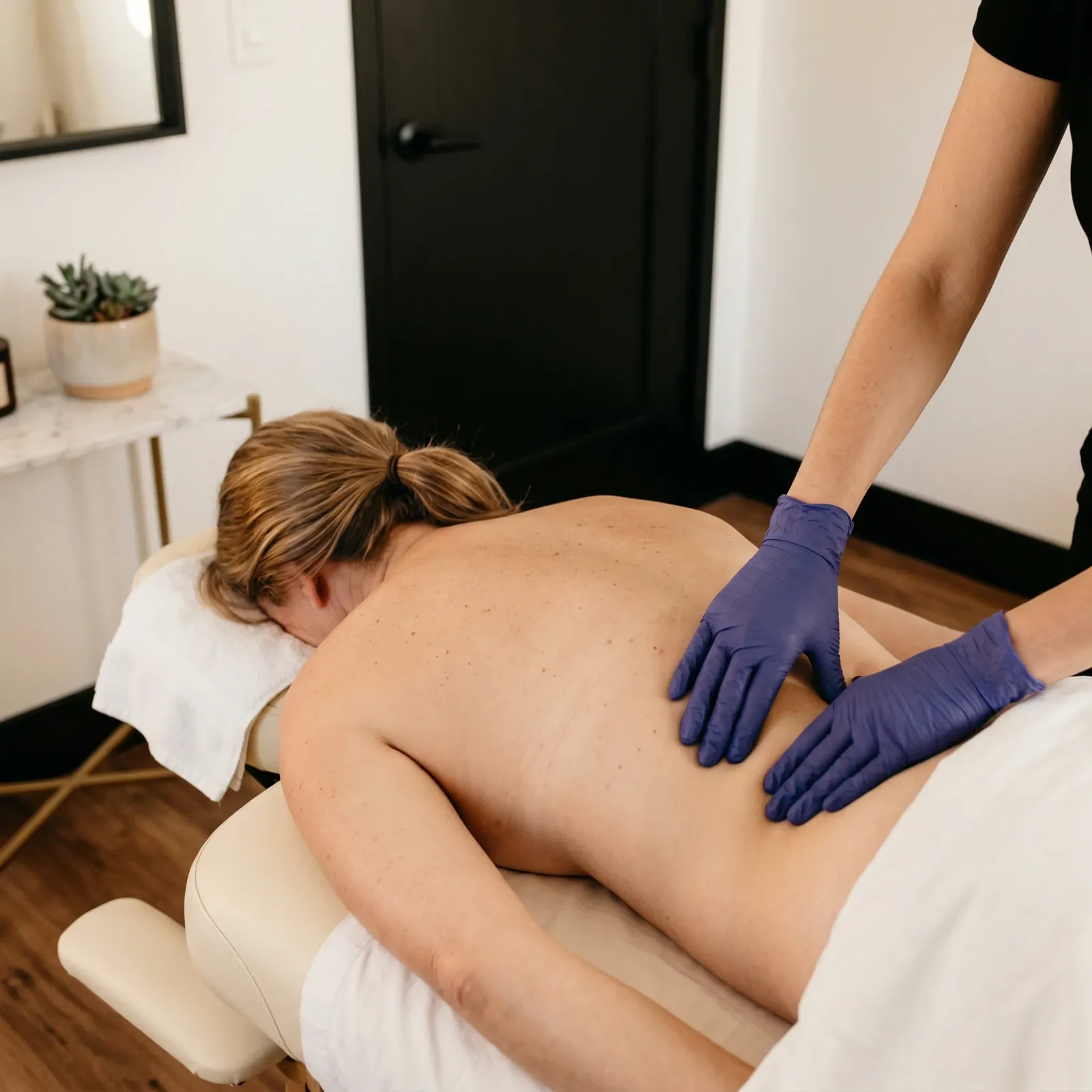
The second thing worth knowing is what an osteopathic session is not. It is not a massage, and it is not an adjustment. It is a whole-body structural read followed by gentle, deliberate manual work, usually on regions away from the painful one. If nobody has explained that before your first appointment, the session tends to feel underwhelming when it is actually doing the intended thing.
A whole-body read before any treatment.
The appointment opens with a detailed history — symptoms, prior injuries, daily habits — followed by a structural assessment across posture, joint mobility and tissue quality in multiple regions rather than just the one that hurts. What that finds is explained to you as it is found, so the plan is not a surprise.
- Symptom history, prior injuries and daily loading habits
- Posture, gait and global movement patterns
- Joint mobility across spine, pelvis and peripheral joints
- Tissue quality: fascia, muscle tone and restriction
What osteopathy is the right first call for.
Osteopathy suits presentations where the sore spot is a symptom of something further up the chain. Across the caseload here it falls into three tiers.
- Chronic pain that keeps coming back to the same place, where treating that place has not held.
- Restricted movement and fascial restriction, including the compensation patterns that build up after an old injury.
- Headaches and neck or jaw tension with a structural driver, assessed as part of a whole-body pattern rather than in isolation.
Gentle work, and an honest count of visits.
The technique is deliberately low-force, so if you are expecting to be cracked or deeply worked you will be surprised. You stay fully clothed. What you should get at the end of a session is a plain account of what was found, what changed, and roughly how many visits this usually takes — including the answer that it may not be the right approach for you.
- Fully clothed for the whole session, every session
- Low-force technique, and you are told before anything is done
- What the next twenty-four hours may feel like
- A visit estimate given up front, and revised out loud if it changes
Osteopathy alongside chiropractic, physiotherapy and massage.
Osteopathy sits in a clinic that also staffs three college-regulated manual disciplines. That matters if regulation is important to you, or if your insurer reimburses some professions and not others: the alternative is not another clinic, it is another room.
- Three chiropractors, a physiotherapist and six RMTs practise in the same clinic
- If your plan does not reimburse osteopathy, a regulated alternative is available in-house
- Your history carries across practitioners without being re-taken
- Co-treatment is recommended when it helps, and not when it does not
When an Osteopath Isn't the Right First Call
Red flags: see a physician first
Suspected fracture, progressive weakness or numbness, loss of bladder or bowel control with back pain, a hot swollen joint with fever, unexplained weight loss alongside pain, or a sudden severe headache unlike any you have had. Any of these needs medical assessment before manual therapy of any kind.
We screen at intake
The first appointment includes a full history and structural assessment before any hands-on work. If what it finds sits outside the scope of manual osteopathy, you will be told plainly and pointed to the right place rather than treated around.
When a regulated discipline fits better
If you want a practitioner accountable to a provincial college, or your insurer reimburses only regulated professions, chiropractic, physiotherapy and massage therapy are all regulated in Ontario and all three are practised in this building. That is a legitimate reason to choose one of them over osteopathy, and we would rather say so than talk you out of it.
Who you will actually see.
One osteopathic manual practitioner, which means the person who assesses you is the person who treats you at every visit.

Osteopathic Manual Practitioner · M.OMSc
Dina Ibrahim, M.OMSc
Holds a Master of Osteopathic Manipulative Sciences and practises myofascial release, post-isometric relaxation, counterstrain and soft-tissue mobilization. Works to A.T. Still's four core principles, treating restriction wherever it appears rather than only at the site of pain. Patients remain fully clothed.
- M.OMSc — Master of Osteopathic Manipulative Sciences
- Member, Ontario Association of Osteopathic Manual Practitioners
- Myofascial release and post-isometric relaxation
- Counterstrain and soft-tissue mobilization
- Patients remain fully clothed
Osteopathy at Essential Health is the page for the treatment itself — what a session involves, how it differs from chiropractic and physiotherapy, and what it is used for. This page is about the practitioner and how to vet one.
Sessions this practitioner performs.
Osteopathic manual therapy is the single service delivered by the practitioner on this page. What happens inside the session is decided by the structural assessment at your first visit.
Treating a specific concern? Read how we assess and treat back pain, neck pain, and headaches and migraines.
Browse physiotherapy and osteopathy treatmentsWhat patients say about our osteopath
4.9 stars across 407 Google reviews. The osteopathy feedback comes back to the same thing: a practitioner who explains what is happening in your body rather than just working on it.
“Dina is an excellent Osteopath. She is attentive, professional, and makes you understand what is happening with your body. I highly recommend Dina Ibrahim as your osteopath. Thank you Dona looking forward to our next appointment.”
Book the Osteopath, Not Just the Appointment Slot
One osteopathic manual practitioner at our Woodbridge clinic on Weston Rd, working alongside chiropractic, physiotherapy, massage therapy and psychotherapy. Sessions are fully clothed and low-force, and the first visit is an assessment. No referral required. Osteopathy is not covered by OHIP; most extended health plans reimburse it, and the front desk will check yours before you book a course.